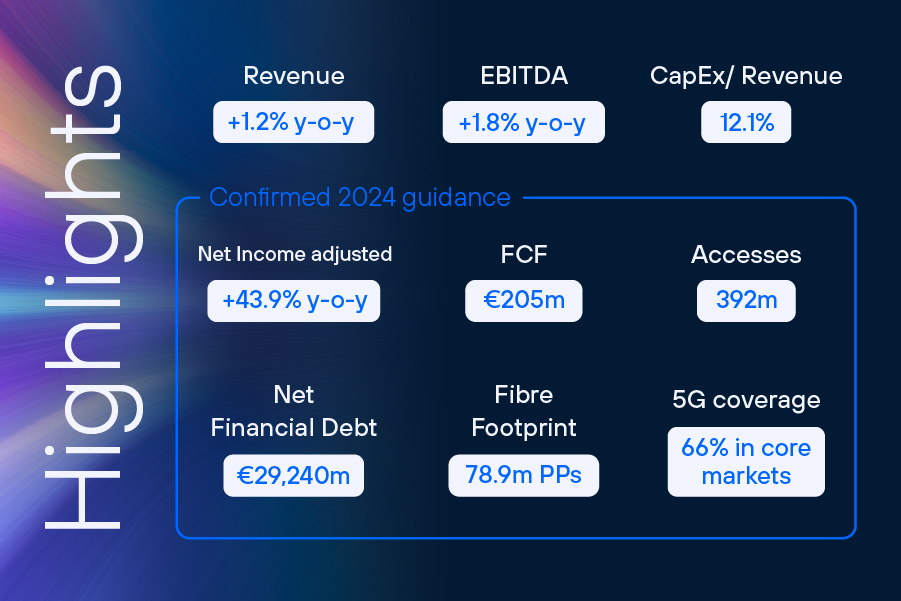
CapEx amounted to €2,299 million in the first half, 3.9% less than in the same period of 2023, after falling 8.9% to €1,243 million in the second quarter. These figures put the ratio of investment to revenues at 11.3%, consistent with the objective of ending the year below 13% and show that Telefónica continues to roll out its network and defend the leadership of its infrastructures through controlled investment.
Reflecting the company's more efficient growth and improved profitability, operating cash flow (EBITDaL-Capex) rose 3.1% in the first half to €2,748 million, after accelerating 11.5% in the second quarter.
Free cash flow amounted to €205 million in the second quarter. Excluding extraordinary items, it would have reached €484 million, a clear progression compared to the first quarter that will continue in the second half of the year to meet the announced target of growth of more than 10% by 2024.
Growth and loyalty in Spain
The favorable performance in the first half of the year and the acceleration in the second quarter were specially reflected at Telefónica España. In the second quarter accesses grew in all the main segments: fixed broadband, mobile contract, television and convergent accesses.
As a result, quarterly revenues rose 1% to €3,127 million and EBITDA increased 0.6% to €1,114 million. For the first half, revenues were up 1% to €6,245 million and EBITDA rose 0.4% to €2,231 million.
Positive evolution in Tech and Infra
Telefónica Tech ended the first half with double-digit revenue growth (+11.1%) to a total of €984 million. The commercial strength recorded, and the sales flow allow Telefónica's digital and technology business unit to maintain a positive revenue generation outlook for the rest of the year.
Telefónica Infra recorded a total of 23 million premises passed in June with the various existing fibre vehicles and more than 100,000 km of international connectivity via submarine cable. Telxius, the cable operator, continued to stand out for its high profitability ratio, with an EBITDA margin of 49.4% in the first half.
Increased access and satisfaction of the customer base
The Group's customer base reached 392 million, 2.2% more than a year earlier. Of note was the growth in fibre accesses (+12.1%) and mobile contract customers (+3.3%).
This favorable evolution is also reflected in higher customer satisfaction, with an NPS ('Net Promoter Score') 2 percentage points higher than in the first quarter.
Active management of technological cycles
The greater degree of virtualisation already in place in Telefónica's infrastructures has enabled to accelerate the development of fibre and 5G technology, as well as the switch-off of retail copper service in Spain. The company maintained its position as the global leader in fibre, with 177 million ultrafast broadband premises passed, up 4%, of which a total of 78.9 million were FTTH (+13%), including 23 million UUII from the Group's various fibre vehicles. In the second quarter alone, the number of FTTH premises increased by 2.3 million, 51% of which were deployed by Telefónica's fibre vehicles.
In 5G, Spain maintains 89% population coverage, Germany 96%, Brazil 50% and 65% in the UK. Moreover, 5G Stand Alone, already commercially launched in the four major markets, enhances the customer experience and enables companies to deploy advanced mobile connectivity services. The different network cores have been fully upgraded in these markets to handle all types of traffic (4G, 5G NSA and 5G SA) and it is equally relevant to highlight the fact that the network slicing services provided by the 5G SA network are already generating revenues.
Recognitions in Sustainability
Telefónica continues to make progress across the pillars of ESG and has gained several new international recognitions during the last quarter. Telefónica has been named as one of the Top 10 World’s Most Sustainable Companies by TIME magazine and has once again been ranked as a sector leader in the FTSE4Good Index Series.
On the environmental front, the Board of Directors approved the 2024 Climate Action Plan, which includes updated targets to achieve a 90% reduction in global operational emissions (Scopes 1 and 2) by 2030. In the quarter, Telefónica Brazil also unveiled a new objective to reach net zero emissions by 2035, five years ahead of the previous target.
With regards to social matters, Telefónica was ranked as the best company in the ICT sector - out of a total of 2,000 companies evaluated- by the World Benchmarking Alliance’s Social Benchmark, which evaluates Human Rights, decent work and ethical behaviour.
Finally, in terms of governance, the company has updated its ethical AI principles to include a new commitment to leverage Artificial Intelligence as a differential tool to address environmental challenges and the promotion of ethical AI across the value chain to ensure traceability.